



Enjoy our free online courses, wherever you are and whenever you want. Access course content on mobile, tablet or desktop
Course categories
Skip available courses
Available courses
TEAMWORK IN MULTIDISCIPLINARY HEALTH SETTINGS:
Get doctors, nurses and support staff working as one team. Participants learn to resolve conflict across professional boundaries, hand over efficiently and use structured communication tools such as SBAR to improve team safety and patient outcomes.
MODULES
1. Clarifying Roles & Responsibilities Across Disciplines
2. Structured Communication Tools: SBAR and Consistent Handoffs
3. Conflict Management & Collaborative Decision-Making
4. Briefings, Debriefings & Shared Goal Alignment for Patient Safety
WHO SHOULD ATTEND
- Nurses
- Physicians
- Specialists
- Administrative and support staff
COMPASSIONATE & PATIENT-CENTRED COMMUNICATION
Communicate with patients and families with empathy and clarity. Participants practise managing difficult conversations, using non- verbal cues and maintaining patient dignity, to improve patient experience, compliance and outcomes.
MODULES
1. Empathetic Listening & Building Trust with Patients
2. Communicating Medical Information Clearly & Ethically
3. Managing Patient Anxiety & Difficult Conversations
4. Structuring Patient-Centred Conversations for Better Outcomes
WHO SHOULD ATTEND
- Nurses
- Front office staff
- Physicians and specialists
QUALITY & PATIENT SAFETY MANAGEMENT:
Build a culture of safety that reduces errors and protects patients. Covers quality management, patient safety principles, risk reduction, clinical governance and continuous quality improvement.MODULES
1. Foundations of Quality & Patient Safety, and Leadership's Role
2. Incident Analysis & Clinical Error Prevention
3. Quality Improvement Tools: PDSA, 5S, Lean & Workflow Mapping
4. Implementing & Sustaining Safety Programmes with KPIs and Audits
WHO SHOULD ATTEND
- Healthcare managers and administrators
- Nurses
- Supervisors
- Support staff
LEADERSHIP & STAFF RETENTION IN HEALTHCARE
Keep your best clinical and support staff and keep them motivated.
Leaders learn to apply evidence-based retention strategies, including stay interviews and professional development pathways, to reduce turnover and protect institutional knowledge.
MODULES
1. Strategic Leadership for a Thriving, Resilient Workforce
2. Retention Strategies: Stay Interviews, Mentorship & Development Pathways
3. Resilience Coaching, Recognition & Motivational Engagement
4. Conflict Resolution & Promoting Psychological Safety
WHO SHOULD ATTEND
- Supervisors
- Unit heads
- Administrators
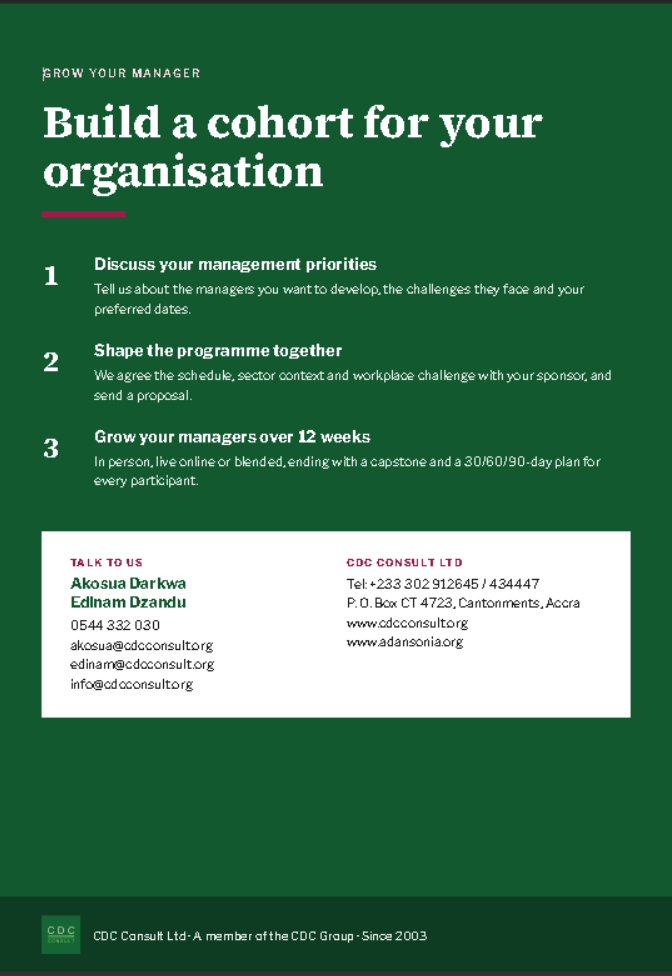
MANAGING THE ORGANISATION
Connect team decisions to wider value. 20 facilitated hours
- 4.1 Strategic thinking and organisational value 3 h
- 4.2 Business acumen and financial awareness 3 h
- 4.3 Stakeholders, influence and managing upwards 2.5 h
- 4.4 Leading change and organisational readiness 3 h
- 4.5 Innovation, work redesign and digital transformation 2.5 h
- 4.6 Risk, controls and organisational accountability 2 h
P.1 Integrated capstone, development plan and programme close 4 h
Plus 2 hours of preparation and 4 hours of workplace application. Capstone hours are included in the session
total.
MANAGING PEOPLE
Build performance through people. 21 facilitated hours
- 3.1 Performance management and underperformance 3.5 h
- 3.2 Motivation, engagement, trust and psychological safety 2.5 h
- 3.3 Professionalism, difficult behaviour and fair intervention 2 h
- 3.4 Conflict resolution and difficult conversations 3 h
- 3.5 Leading age-diverse and multigenerational teams 3.5 h
- 3.6 Developing people, inclusive teams and succession 2.5 h
- 3.7 Managerial AI literacy, responsible use and human oversight 4 h
Plus 2 hours of preparation and 4 hours of workplace application.
MANAGING WORK
Turn objectives into reliable delivery. 22 facilitated hours
- 2.1 Goals, standards and team objectives 2.5 h
- 2.2 Planning, priorities and workload 2 h
- 2.3 Delegation, empowerment and accountability 3 h
- 2.4 Communication, listening and questioning 3 h
- 2.5 Feedback, coaching and developmental conversations 3 h
- 2.6 Meetings, collaboration and team coordination 2 h
- 2.7 Problem-solving, evidence and managerial decisions 2.5 h
- 2.8 Leading remote, hybrid and distributed work 4 h
Plus 2 hours of preparation and 4 hours of workplace application.
SELF
Lead yourself with judgment. 15 facilitated hours
- 1.1 Understanding management and leadership 3 h
- 1.2 Becoming a manager and achieving results through others 2 h
- 1.3 Self-awareness, emotional intelligence and adaptive leadership 2.5 h
- 1.4 Values, ethics and managerial credibility 2.5 h
- 1.5 Personal effectiveness, resilience and boundaries 2.5 h
- 1.6 Managing in a changing world of work 2.5 h
Plus 2 hours of preparation and 4 hours of workplace application.
DELIVERING EXCEPTIONAL CUSTOMER SERVICE IN FMCG MARKETS
Deliver service that keeps trade customers coming back. Practical skills for serving retailers, wholesalers and distributors consistently well in fast-moving, high-pressure trade channels.
MODULES
1. Understanding FMCG Customer & Trade Dynamics
2. Building Strong, Professional Distributor Relationships
3. Managing Complaints and Trade Issues Professionally
4. Service Excellence Techniques for Loyalty & Repeat Purchase
5. Linking Service Quality to Sales Performance & Brand Visibility
WHO SHOULD ATTEND
- Sales representatives
- Distributor relationship managers and officers
- Depot and branch frontline staff
EFFECTIVE TRADE MARKETING & MERCHANDISING FOR MARKET GROWTH
Win at the shelf with stronger visibility and availability. Hands-on skills in merchandising standards, shelf management, point-of-sale execution, planogram compliance and promotional activation.
MODULES
1. Merchandising Standards & Shelf Management
2. Point-of-Sale Execution & Planogram Compliance
3. Designing and Implementing Trade Marketing Activations
4. Monitoring & Reporting Retail and Wholesale Activation Performance
WHO SHOULD ATTEND
- Merchandisers
- FMCG sales representatives
BUILDING COMPETITIVE ADVANTAGE THROUGH DISTRIBUTOR PARTNERSHIPS: Turn distributors into a lasting competitive advantage. Through industry case studies, participants explore partnership models, joint planning and engagement tools that strengthen the manufacturer–distributor bond.
MODULES
1. Understanding the Distributor–Manufacturer Value Chain
2. Partnership Engagement Models that Build Distributor Loyalty
3. Developing Joint Business Plans for Market Expansion
4. Strengthening Route-to-Market Communication & Collaboration
WHO SHOULD ATTEND
- Marketing managers
- Sales managers
- Territorial managers
- Distributor relationship managers
INTEGRATING SUSTAINABILITY INTO BUSINESS STRATEGY
Embed sustainability into strategy, operations, and the bottom line. Covers ESG frameworks, sustainable supply chain practices, resource efficiency and responsible business approaches for FMCG organisations.
MODULES
1. ESG Frameworks and Their Relevance to FMCG Value Chains
2. Sustainable Sourcing, Manufacturing & Distribution Practices
3. Conducting Environmental & Social Risk Assessments
4. Embedding Sustainability Goals into Strategy and Brand Positioning
5. Sustainability Reporting & Stakeholder Communication
WHO SHOULD ATTEND
- CSR teams
- Sustainability leads
- Executive management
- Operations and compliance officers
- Environmental and safety managers
SUPPLY CHAIN & INVENTORY OPTIMISATION FOR FMCG EFFICIENCY
Cut stock-outs and waste from production to the last mile. Participants explore demand forecasting, stock planning, replenishment cycles and inventory control across the end-to-end FMCG supply chain.
MODULES
1. End-to-End FMCG Supply Chain Fundamentals
2. Demand Forecasting & Replenishment Planning
3. Warehouse Management & Logistics Coordination
4. Identifying and Mitigating Supply Chain Risks
WHO SHOULD ATTEND
- Supply chain officers
- Warehouse staff
- Inventory
- controllers ·
- Logistics coordinators
Data Analytics & Performance Dashboarding for FMCG Teams: See sales and stock performance clearly, and act on it. Introduces the analytics tools and dashboards used to track sales, market execution and stock, and how to turn data into insight for decisions.
MODULES
1. Introduction to FMCG Data Analytics & Dashboarding Tools
2. Reading and Interpreting KPIs & Market Performance Indicators
3. Turning Data into Actionable Business Insights
4. Hands-On Practice with FMCG Datasets and Live Dashboards
WHO SHOULD ATTEND
- Sales analysts
- Trade marketing teams
- Operations analysts
BUILDING AND MANAGING HIGH-IMPACT FMCG OPERATIONS TEAMS
Run warehousing, fleet and logistics teams that deliver Participants learn to create efficient workflows, manage daily performance,
reduce operational risk, and build teamwork in fast-moving environments.
MODULES
1. Structuring High-Performing Operations & Supply Teams
2. Workflow Optimisation & Performance Monitoring
3. Managing Logistics Challenges & Market Replenishment
4. Coaching & Mentoring Frontline and Warehouse Teams
WHO SHOULD ATTEND
- Operations managers
- Warehouse supervisors
- Fleet managers
- Supply chain team leads
STRATEGIC LEADERSHIP FOR HIGH-PERFORMANCE FMCG TEAMS: Lead FMCG teams to win in a fast-moving, competitive market. Participants explore leadership styles, performance management frameworks, and how to influence, coach and drive results in
dynamic sales and operational environments.
MODULES
1. Leadership Foundations for FMCG Environments
2. Decision-Making, Problem-Solving & Cross- Functional Collaboration
3. Leading Through Change, Competition & Market Shifts
4. Communication for Motivation, Accountability & Execution
WHO SHOULD ATTEND
- Middle managers
- Supervisors
- Team leaders
- Departmental managers ·
- Regional coordinators
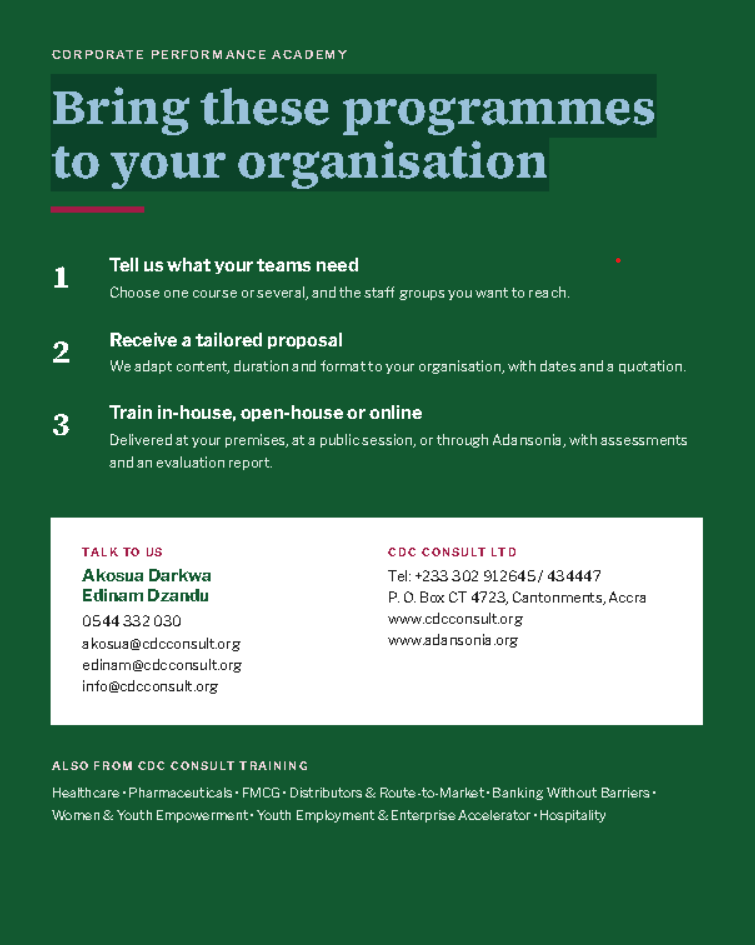
BRING THESE PROGRAMMES TO YOUR DISTRIBUTORS:
1. Tell us what your network needs. Choose one course or several, for a single distributorship or a whole distributor network.
2. Receive a tailored proposal. We adapt content, duration and format to your route-to-market, with dates and a quotation.
3. Train in-house, open-house or online. Delivered at your premises, at a public session, or through Adansonia, with assessments
and an evaluation report.
TALK TO US
Akosua Darkwa
Edinam Dzandu
0544 332 030
akosua@cdcconsult.org
edinam@cdcconsult.org
info@cdcconsult.org
C D C C O N S U LT LT D
Tel: +233 302 912645 / 434447
P. O. Box CT 4723, Cantonments, Accra
ALSO FROM CDC CONSULT TRAINING
- FMCG
- Corporate Performance
- Healthcare
- Pharmaceuticals
- Banking Without Barriers
- Women & Youth Empowerment
- Youth Employment & Enterprise Accelerator
- Hospitality
OPERATIONAL & FINANCIAL SUSTAINABILITY FOR DISTRIBUTORS
Build a distributorship that is efficient and financially sound. Owners and managers learn to manage working capital, control costs, reduce internal risk and streamline logistics for a resilient, profitable distribution model.
MODULES
1. Financial Planning & Cash-Flow Management
2. Cost Control & Operational Efficiency
3. Route-to-Market Optimisation for Market Penetration
4. Identifying & Mitigating Operational Risks
WHO SHOULD ATTEND
- Distributor owners
- Finance officers
- Warehouse managers
WINNING AT LAST MILE DELIVERY
On-time, accurate delivery to every retailer. Participants learn to optimise routes, reduce errors, manage stock in transit and improve
customer satisfaction for stronger sales.
MODULES
1. Route Optimisation & Delivery Scheduling
2. Minimising Errors, Stock-outs & Delays
3. Managing Stock During Transit
4. Customer Satisfaction Through Timely, Accurate Delivery
WHO SHOULD ATTEND
- Delivery drivers
- Territory sales managers
- Distribution
- supervisors
- retailer.
Participants learn to optimise routes, reduce errors, manage stock in transit and improve customer satisfaction for stronger sales.
M O D U L E S
1. Route Optimisation & Delivery Scheduling
2. Minimising Errors, Stock-outs & Delays
3. Managing Stock During Transit
4. Customer Satisfaction Through Timely, Accurate Delivery
WHO SHOULD ATTEND
- Delivery drivers
- Territory sales managers
- Distribution
- supervisors
SALES EFFICIENCY MASTERY FOR DISTRIBUTOR TEAMS
More productive sales teams and sharper route-to-market execution. Through hands-on exercises and real scenarios, sales teams learn to work smarter, strengthen customer relationships and hit targets consistently.
MODULES
1. Daily Sales Planning & Route Efficiency
2. Sales Call Effectiveness & Customer Engagement
3. Digital Tools for Reporting & Performance Tracking
4. Building Consistent, Target-Achieving Workflows
WHO SHOULD ATTEND
- Sales representatives
- Territory sales
QUALITY ASSURANCE AND PRODUCT HANDLING: Protect product integrity from warehouse to customer.
Best practices in handling, inspection and quality control to keep products compliant, minimise damage and improve customer satisfaction through storage, transport and delivery.
MODULES
1. Product Handling & Storage Standards
2. Inspection & Quality Control During Transit and Delivery
3. Minimising Damage, Losses & Compliance Issues
4. Quality as a Driver of Customer Satisfaction
WHO SHOULD ATTEND
- Distribution managers
- Warehouse and inventory staff
DIGITAL TOOLS FOR SALES TRACKING AND MARKET INSIGHTS:
Track sales, forecast stock and measure your team digitally. Build practical skills in CRM and analytics tools to automate sales tracking, forecast inventory needs, and measure sales team performance.
MODULES
1. CRM Systems for Real-Time Sales Pipeline Tracking
2. Sales KPIs, Analytics & Forecasting
3. Gathering Competitor, Trend & Customer Behavioural Data
4. Data Visualisation & Executive-Level Reporting
WHO SHOULD ATTEND
- Distributor owners
- General managers
- Finance managers
CORPORATE GOVERNANCE IN FMCG OPERATIONS
Put in place the controls that keep a distributorship well run. Establishes the oversight structures, controls and accountability that let
distributors manage risk, stay compliant and operate responsibly for the long term.
MODULES
1. Corporate Governance Principles for Distributors
2. Internal Controls, Accountability & Ethical Conduct
3. Tax Compliance & Record-Keeping Essentials
4. Building Transparent, Professionalised Business Structures
WHO SHOULD ATTEND
- Distributor owners
- General managers
- Finance officers
- Warehouse managers
STRATEGIC PLANNING FOR DISTRIBUTOR GROWTH
Move from order-taker to strategic business owner. Participants develop a multi-year strategy that grows volume and profitability and aligns the distributor's objectives with the manufacturer's goals.
MODULES
1. From Order-Taker to Strategic Business Owner
2. Market Analysis & Growth Potential Assessment
3. Building a Data-Driven, Multi-Year Distributor Growth Plan
4. Route-to-Market Optimisation & Execution Monitoring
WHO SHOULD ATTEND
- Distributor owners
- General managers ·
- Accountants
FINANCIAL LITERACY AND CONSUMER EDUCATION: Deliver practical financial education that changes behaviour. Participants will cover financial literacy for women and youth, responsible borrowing and debt management, saving and wealth creation, and insurance and pension awareness.
MODULES
1. Financial Literacy for Women and Youth
2. Responsible Borrowing and Debt Management
3. Savings Culture and Wealth Creation
4. Insurance and Pension Awareness
5. Financial Resilience for Households and Small Businesses
WHO SHOULD ATTEND
- Financial education officers
- Branch and customer service staff; community outreach officers
- Savings group facilitators
- Corporate affairs and marketing officers
INSTITUTIONAL CAPACITY STRENGTHENING IN INCLUSION: Turn inclusion commitments into strategy, systems and results. Participants develop an institutional inclusion strategy, embed diversity, equity and inclusion in daily operations, build inclusive leadership, and learn to measure and report outcomes.
MODULES
1. Developing an Institutional Inclusion Strategy
2. Embedding DEI in Banking Operations
3. Inclusive Leadership for Financial Institutions
4. Measuring and Reporting Financial Inclusion Outcomes
5. ESG and Inclusive Finance
WHO SHOULD ATTEND
- Chief executives and senior management
- Heads of strategy
- HR and diversity officers
- M&E and impact reporting officers
- ESG and sustainability officers
INCLUSIVE RISK MANAGEMENT: Grow inclusive finance without taking on avoidable risk. Participants examine the risks of serving new customer groups, fraud in group and community lending, consumer protection duties and responsible digital lending.
MODULES
1. Managing Risks in Inclusive Finance
2. Fraud Prevention in Group and Community Lending
3. Consumer Protection and Financial Inclusion
4. Responsible Digital Lending
5. Social Performance Management
WHO SHOULD ATTEND
- Risk managers Credit risk officers
- Internal auditors
- Compliance officers
- Consumer protection and social performance officers
MSME Development and Financial Capability: Lend responsibly to MSMEs and build their financial capability. Participants cover responsible lending, financial education for business owners, alternative credit scoring for informal businesses, and the services that make MSMEs more resilient.
MODULES
1. Responsible Lending to MSMEs
2. Financial Education for Small Businesses
3. Savings, Credit, Insurance and Pension Literacy
4. Alternative Credit Scoring for Informal Businesses
5. Building Resilient MSMEs Through Financial Services
WHO SHOULD ATTEND
- SME banking heads
- Credit and loan officers
- Relationship managers
- Financial education officers
- Branch managers of microfinance, savings and loans, and credit union institutions
DIGITAL FINANCIAL INCLUSION: Use digital channels to bring the unbanked into formal finance. Participants look at digital banking for underserved groups, fintech partnerships, mobile money integration and interoperability, and the digital literacy support customers need.
M O D U L E S
1. Digital Banking for Underserved Populations
2. Fintech Partnerships for Inclusive Banking
3. Digital Literacy and Customer Adoption
4. Mobile Money Integration and Interoperability
5. Overcoming Digital Exclusion
WHO SHOULD ATTEND
- Digital banking managers
- Product managers
- Fintech partnership leads
- Agent network managers
- Mobile money operations officers
AGRICULTURAL AND RURAL FINANCIAL INCLUSION: Extend finance profitably to smallholders and rural communities. Participants examine value chain financing, digital and agency banking, and the challenges of last-mile delivery, with particular attention to women and young farmers.
M O D U L E S
1. Expanding Financial Access for Smallholder Farmers
2. Value Chain Financing for Women and Youth in Agriculture
3. Digital Solutions for Community Banking
4. Agency Banking and Last-Mile Financial Service Delivery
5. Climate-Smart Agricultural Finance
WHO SHOULD ATTEND
- Agricultural finance managers
- Credit and loan officers
- Community bank and credit union managers
- Agency banking managers
- Value chain finance officers
YOUTH BANKING AND ENTREPRENEURSHIP: Attract, serve and grow with young customers. Participants learn to design youth-friendly products, finance young entrepreneurs and start-ups, and use the digital channels young people actually use.
M O D U L E S
1. Youth-Friendly Financial Products and Services
2. Financing Young Entrepreneurs and Start-ups
3. Digital Financial Solutions for Youth
4. Building Financial Capability Among Young Customers
5. Youth Employment and Enterprise Development
WHO SHOULD ATTEND
- Product development managers
- Retail banking heads
- Digital banking officers
- Marketing managers
- Youth and SME programme officers
WOMEN'S ECONOMIC EMPOWERMENT IN FINANCIAL SERVICES: Treat women as a distinct, underserved and bankable market. Participants study the women's segment, design banking and SME financing offerings, explore gender lens investing, and examine the barriers women face in accessing finance.
M O D U L E S
1. Understanding the Women's Market Segment
2. Women's Banking and SME Financing
3. Gender Lens Investing
4. Addressing Barriers to Women's Access to Finance
5. Leadership and Entrepreneurship Support for Women-Owned Businesses
WH O S H O U L D AT T E N D
- Retail and SME banking managers
- Relationship managers
- Product development officers
- Gender and inclusion officers
- Investment officers
DISABILITY INCLUSION IN FINANCIAL SERVICES: Serve customers with disabilities as a normal part of business.
Participants examine disability-inclusive banking practices, the accessibility of physical and digital channels, and the communication skills frontline staff need, and set out the business case for leaders.
MODULES
1. Disability-Inclusive Banking Practices
2. Making Branches, ATMs and Digital Channels Accessible
3. Communication and Customer Service for Persons with Disabilities
4. Using Disability Inclusion Toolkits
5. Business Case for Disability Inclusion in Finance
WHO SHOULD ATTEND
- Branch managers ·
- Frontline and customer service staff ·
- Digital channels and ATM operations managers ·
- Compliance and inclusion officers · HR managers
INCLUSIVE FINANCE AND CUSTOMER- CENTRIC BANKING: Design products and services that reach underserved customers. Participants explore the principles of Banking Without Barriers, learn how to design customer-centric products, and examine gender-responsive approaches to banking.
MODULES
1. Principles of Banking Without Barriers
2. Designing Inclusive Financial Products for Women and Youth
3. Financial Inclusion Strategies for Underserved Markets
4. Customer-Centric Product Development
5. Gender-Responsive Banking
WHO SHOULD ATTEND
- Product development managers
- Retail and SME banking heads
- Branch managers
- Marketing and customer experience officers
- Strategy and inclusion officers
STRENGTHENING INTERNAL CONTROL FROM WITHIN :
Make internal control everyone's job, not just audit's
Builds ownership, transparency and operational discipline by strengthening accountability, risk awareness and process discipline among staff at all levels.
MODULES
1. Internal Control Frameworks & Organisational Risk Exposure
2. Practical Tools for Strengthening Unit-Level Controls
3. Detecting, Preventing & Reporting Fraud and Process Failures
4. Building a Culture of Transparency, Ownership & Operational Discipline
WHO SHOULD ATTEND
- Staff with operational responsibilities
- Finance, compliance and internal audit teams
- Supervisors and middle managers
- Operations and administrative teams
- Frontline and back-office staff
AROT: ACHIEVING RESULTS-ORIENTED TRAINING :
Equip your internal trainers to deliver training that changes performance.
A Training of Trainers programme covering adult learning principles, training design, facilitation techniques, digital training tools and evaluation frameworks.
MODULES
1. Adult Learning Principles & Instructional Design
2. Facilitation Techniques: Presentation, Engagement & Coaching
3. Translating Organisational Needs into Effective Training Modules
4. Digital Training Tools & Managing Diverse Audiences
5. Learning Evaluation, Feedback & Measuring Training ROI
WHO SHOULD ATTEND
- HR and training officers
- Supervisors and managers who train teams, internal trainers
- Subject matter experts
- Coaches and learning facilitators
BUILDING A CULTURE OF ACCOUNTABILITY & HIGH-PERFORMANCE TEAMS:
Build teams that own their results, without being chased.
Through practical exercises and case studies, participants learn how accountability improves productivity, reduces internal conflict and strengthens teamwork.
MODULES
1. Frameworks for Setting Expectations & Personal Ownership
2. Teamwork, Collaboration & Goal Alignment Across Departments
3. Constructive Feedback, Role Clarity & Performance Discussions
4. Embedding Transparency, Discipline & Consistent Results
WHO SHOULD ATTEND
- Supervisors and team leaders
- Middle managers
- Project leads
- Heads of department
- Cross-functional team members
THE WINNING SALES TEAM:
Turn your sales team into a customer-centric revenue engine.
A sales and customer experience accelerator that combines sales psychology, customer experience strategy, digital prospecting and performance measurement.
MODULES
1. Modern Selling Techniques & Value-Based Selling
2. Understanding Customer Needs & Delivering Memorable Experiences
3. Sales Pipeline Management, Closing & Reducing Churn
4. Negotiation, Objection Handling & Converting Prospects to Loyal Customers
5. Teamwork, Accountability & Performance Discipline in Sales
WHO SHOULD ATTEND
- Sales executives
- Relationship managers
- Business development officers
- Customer service teams
COMMUNICATION & EMOTIONAL INTELLIGENCE IN THE WORKPLACE:
Communicate with clarity and manage emotions under pressure. Participants explore practical models for managing emotions, interpreting cues, giving and receiving feedback, and communicating tactfully and professionally.
MODULES
1. Foundations of Workplace Communication & Emotional Intelligence
2. Active Listening, Non-Verbal Cues & Giving and Receiving Feedback
3. Managing Emotions and Navigating Conflict Constructively
4. Applying EQ to Build Trust, Cohesion & Cross-Department Collaboration
WHO SHOULD ATTEND
- All employees
- Team leaders and supervisors
- Managers
- Client-facing staff
- Project teams
- HR and administrative staff


- A comprehensive Entrepreneurship Development Program.
- Targets technically skilled youth and women such as technical university graduates, technical and vocational institutions trainees and generally business minded youth and women who are aspiring entrepreneurs.
- Implemented by CDC Group. A Ghanaian group of indigenous businesses with over 20 years of experience in SME and Entrepreneurship Development.
- Facilitated by seasoned consultants with rich industry experience and excellent understanding of the SME and Entrepreneurship landscape.
- Delivered in a combination of online, off-line and in-person methodologies.
SHS & TVET Graduate
SHS & TVET IDEATION STAGE
FEASIBILITY STUDY ON BUSINESS CONCEPT
BUSINESS MODELING AND ENTERPRISE PLANNING
BUSINESS FORMATION AND LAUNCHING
INTRODUCTION TO ENTERPRISE FINANCE
INTRODUCTION TO MARKETING
The half-day training program is designed to build the capacity of
partner financial institutions (FIs) to understand and integrate Environmental,
Social, and Governance (ESG) principles into their operations. The course will
inspire leadership and key actors of partner institutions to take practical
steps toward improving ESG practices and aligning with national and global
standards. Through interactive and tailored content, participants will explore
the benefits of ESG adoption and reporting, assess their institutional
readiness, and develop a road map for sustainable implementation, leveraging
Ghanaian examples and regulatory frameworks
The half-day training program is designed to build the capacity of
partner financial institutions (FIs) to understand and integrate Environmental,
Social, and Governance (ESG) principles into their operations. The course will
inspire leadership and key actors of partner institutions to take practical
steps toward improving ESG practices and aligning with national and global
standards. Through interactive and tailored content, participants will explore
the benefits of ESG adoption and reporting, assess their institutional
readiness, and develop a road map for sustainable implementation, leveraging
Ghanaian examples and regulatory frameworks

The half-day training program is designed to build the capacity of
partner financial institutions (FIs) to understand and integrate Environmental,
Social, and Governance (ESG) principles into their operations. The course will
inspire leadership and key actors of partner institutions to take practical
steps toward improving ESG practices and aligning with national and global
standards. Through interactive and tailored content, participants will explore
the benefits of ESG adoption and reporting, assess their institutional
readiness, and develop a road map for sustainable implementation, leveraging
Ghanaian examples and regulatory frameworks
The half-day training program is designed to build the capacity of
partner financial institutions (FIs) to understand and integrate Environmental,
Social, and Governance (ESG) principles into their operations. The course will
inspire leadership and key actors of partner institutions to take practical
steps toward improving ESG practices and aligning with national and global
standards. Through interactive and tailored content, participants will explore
the benefits of ESG adoption and reporting, assess their institutional
readiness, and develop a road map for sustainable implementation, leveraging
Ghanaian examples and regulatory frameworks
The half-day training program is designed to build the capacity of
partner financial institutions (FIs) to understand and integrate Environmental,
Social, and Governance (ESG) principles into their operations. The course will
inspire leadership and key actors of partner institutions to take practical
steps toward improving ESG practices and aligning with national and global
standards. Through interactive and tailored content, participants will explore
the benefits of ESG adoption and reporting, assess their institutional
readiness, and develop a road map for sustainable implementation, leveraging
Ghanaian examples and regulatory frameworks
The half-day training program is designed to build the capacity of
partner financial institutions (FIs) to understand and integrate Environmental,
Social, and Governance (ESG) principles into their operations. The course will
inspire leadership and key actors of partner institutions to take practical
steps toward improving ESG practices and aligning with national and global
standards. Through interactive and tailored content, participants will explore
the benefits of ESG adoption and reporting, assess their institutional
readiness, and develop a road map for sustainable implementation, leveraging
Ghanaian examples and regulatory frameworks
Client service delivery in a financial institution set up has a unique set of challenges. Among these are issues such as confidentiality, management of people in financial crisis and desperation. It also involves service delivery to clients from a variety of social backgrounds among others. This course open participants up to the peculiar issues to consider in serving their clients. It is tailor-made for financial institutions to ensure that they do not only meet their clients expectations, but also exceed them.
Credit providing institutions are critical for enterprises and the wider economy and their operations impact on various aspects of the economy. For effective and impactful credit delivery to be realised, credit providing institutions must operate within a well thought through institutional framework. The course provides the required knowledge and skills for operating an effective credit delivery enterprise. It ensures that learners are able to strengthen their overall credit management practices spanning the articulation of credit philosophy, formulation of credit strategy, development and roll out of credit policies and procedures.
Private Schools are businesses and should be managed as such. The course in business plan development provides learners with a comprehensive introduction to the basic principles and underlying concepts of business plan development for private schools. It makes a strong case for schools to develop business plans to serve as planning, management, and a communication tool.
Looking for a job can be one of the most stressful times in a young adult’s life. To complicate the search process, the COVID-19 pandemic has made it more competitive due to lay-offs and tight budgets. In short, very few are recruiting. Chances of getting a job could be simpler if you knew how to sell yourself properly and knew what recruiters and employers want in a candidate. This course prepares individuals searching for job opportunities with the knowledge and tips to make them first choice candidates in the recruitment and selection process.
this course for the banking sector and its an introdutory cousre